memory. language, art. wittgenstein. books. ceramics.
all sorts of thinkings on memory, language, art, wittgenstein, books, etc, while I am getting on with my MA
Showing posts with label About my books. Show all posts
Friday, 13 May 2011
Books in Bronze: Friday 13
Friday 13 must be a good day for burning books!
This was my first attempt at bronze casting and I am pleased - oh, so pleased - with the results: the detail, the colours, the mutilation!
Saturday, 26 March 2011
Fired books. Birds eye view.
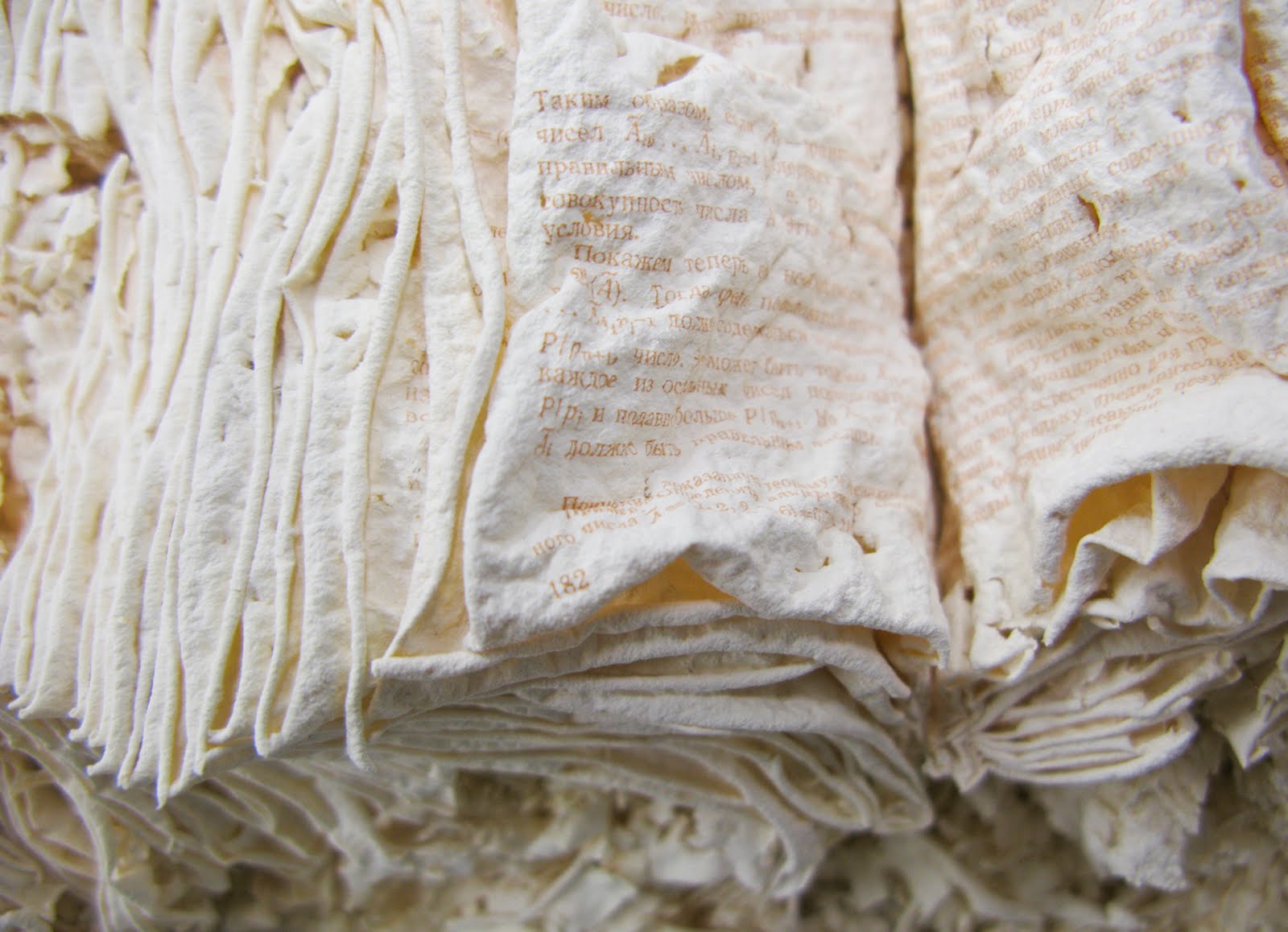
One of my books did not shrink in firing - little bugger! It fused flat, forming a beautiful desolate white landscape.
Wednesday, 16 March 2011
A trace of 1968.
![]() |
Traces. The Truth of Blacksmith Ignotas
Some of the books have been damaged and I had to remove them from their bases. I was amazed to find those beautiful traces of the books absorbed into the white earthenware: some ash fused into a glaze, markings of iron (?) in the ink. Mesmerizing.
Wednesday, 9 March 2011
Compulsive hoarding and letting my artwork go.
I do not let things go easily. I am a hoarder. Our loft and basement are full to the brim. I am running out of space in my studio room too. I remember reading somewhere an interview with Cornelia Parker. She said she started going suspended sculpture, because that was the only clear space in her house. She is hoarder as well. Susan Hiller is a hoarder too. Not a bad company - see!
Anyway - I do not let things go easily - and that includes my work*. Therefore, it was highly therapeutic for me to spend the private view talking to all those people of very very different arts/non-arts backgrounds, who were interested in my work. It almost felt that the work did not belong to me anymore. It had a life of it's own. And - wow - it was fascinating to watch that life! Many were intrigued/mortified by the fact that I burn books; but they were simultaneously drawn by the beauty of the result. Some were curious about the history and the background of my work. Some were asking about the techniques. Some were taken by the fragility. Many asked about the title. Some thought it was good example of how open-minded book arts are. Some asked about my course, assuming I was a good representation of it (I am not).
I have a few more of those 1968 pieces. Some are damaged, some went wrong. Why do I keep them?
Here is an article about Song Dong installation and compulsive hoarding.
*Not the certain work from about a year ago, that I passionately want to burn (and keep the ashes of course!)
Wednesday, 23 February 2011
Xhibit 2011 and more fired books
My work will be shown at Xhibit 2011 March 02-21.
Unfortunately my submission piece got flattened. (It might be suitable for another occasion) - I am in the process of getting the new one made. There are two more books coming out of the kiln this week. It may seem boring and repetitive, but I get so SO (really - SO!!!) excited each time when Tim opens the kilns.


I promised to myself, to move on with my book firing - after this week. Yehhh, right...
Unfortunately my submission piece got flattened. (It might be suitable for another occasion) - I am in the process of getting the new one made. There are two more books coming out of the kiln this week. It may seem boring and repetitive, but I get so SO (really - SO!!!) excited each time when Tim opens the kilns.


I promised to myself, to move on with my book firing - after this week. Yehhh, right...
Friday, 18 February 2011
Wednesday, 16 February 2011
Thursday, 3 February 2011
Burning books - no11; 1968.


I am taking books, that no longer have the society that supports them (uh! I have got a barn full of them!) and I reduce them to an immensely fragile state (firing in the kiln) - so fragile, that they may disintegrate in hands - just like the memory of the times, that they represent.
Wednesday, 2 February 2011
Burning books - why???!!!

I do not burn them because I have a problem with books and written word. I do not burn them as a political statement.
I reduce books to the fragility of an empty crab shell, not only because it is a book, but especially because of it's indexality (Charles Sanders Peirce). Those books that I fire are very much representative of their times. Not only for the truths they contain. The books also hold ink, dust, fingerprints, pigments, coffee stains, pencil marks and other residue from that specific moment. So I cremate them, purge them of the memories and thoughts. I reduce their materiality and their content to such fragility, that they may disintegrate in hands, just like the memory of the times that they represent. The beauty of death.
Firing books comes from my research into memory, identity, language and aesthetics. My firing practice is not there only to speak about books. It is also there to raise questions about memory, identity, historical truth, our links with past and the fragility of those links.
This is why I burn books.
Well - this is what I think. I am sure Freud would have a more exciting explanation.
Saturday, 29 January 2011
Burning books - no11; 1969


1969. Blank.
The number of books in young people's personal libraries increased 60 per cent. (from Illustrated History of the USSR)So?
I am taking books, that no longer have the society that supports them (uh! I have got a barn full of them!) and I reduce them to an immensely fragile state (firing in the kiln) - so fragile, that they may disintegrate in hands - just like the memory of the times, that they represent.
Burning books - no10; 1978
Before:


After:

This one has been completely destroyed. I do like the aesthetics of it, even though, the outcome looks like a disaster. I do like this book. I love the traces on the clay and metal clips. It is also holding better together, so it could be mounted on the wall.
Where do I find a studio with a kiln for the future?
I am taking books, that no longer have the society that supports them (uh! I have got a barn full of them!) and I reduce them to an immensely fragile state (firing in the kiln) - so fragile, that they may disintegrate in hands - just like the memory of the times, that they represent.
Tuesday, 14 December 2010
Wednesday, 21 July 2010
my work: monomyth journey I-1

"Mapping the Myth of My Own I"
journey 1
Mapping human experience. Where do I come from. What is the path. What is left of the source. The metomorphosis.
In simple words: I am taking personal knowledge (dealing with disappointment, anger, difficult relatives, search for the grail ) as a background; I try to explain it and structure it using monomyth.
The drawings are a map. They represent (rather than depict) schema of the events.


PS: Joseph John Campbell (March 26, 1904 – October 30, 1987) was an American mythologist, writer and lecturer, best known for his work in comparative mythology and comparative religion. His work is vast, covering many aspects of the human experience. His philosophy is often summarized by his phrase: "Follow your bliss."
Joseph Campbell's term monomyth, also referred to as the hero's journey, refers to a basic pattern found in many narratives from around the world. This widely distributed pattern was described by Campbell in The Hero with a Thousand Faces (1949).
my work: monomyth journey I-2

"Mapping the Myth of My Own I"
journey 2
Mapping human experience. Where do I come from. What is the path. What is left of the source. The metamorphosis.
In simple words: I am taking personal knowledge (dealing with disappointment, anger, difficult relatives, search for the grail ) as a background; I try to explain it and structure it using monomyth.
The drawings are a map. They represent (rather than depict) schema of the events.


PS: Joseph John Campbell (March 26, 1904 – October 30, 1987) was an American mythologist, writer and lecturer, best known for his work in comparative mythology and comparative religion. His work is vast, covering many aspects of the human experience. His philosophy is often summarized by his phrase: "Follow your bliss."
Joseph Campbell's term monomyth, also referred to as the hero's journey, refers to a basic pattern found in many narratives from around the world. This widely distributed pattern was described by Campbell in The Hero with a Thousand Faces (1949).
my work: monomyth journey I-3

"Mapping the Myth of My Own I"
journey 3
This is all about mapping human experience onto the structure of monomyth. Taking my personal knowledge (dealing with disappointment, anger, difficult relatives, search for the grail ) as a background; I try to explain it and structure it using monomyth.
The drawings are a map. They represent (rather than depict) schema of the events.
Trying to map the workings of my mind.


PS: Joseph John Campbell (March 26, 1904 – October 30, 1987) was an American mythologist, writer and lecturer, best known for his work in comparative mythology and comparative religion. His work is vast, covering many aspects of the human experience. His philosophy is often summarized by his phrase: "Follow your bliss."
Joseph Campbell's term monomyth, also referred to as the hero's journey, refers to a basic pattern found in many narratives from around the world. This widely distributed pattern was described by Campbell in The Hero with a Thousand Faces (1949).
my work: monomyth journey I-4

"Mapping the Myth of My Own I"
journey 4
Mapping human experience. Where do I come from. What is the path. What is left of the source. The metamorphosis.
In simple words: I am taking personal knowledge (dealing with disappointment, anger, difficult relatives, search for the grail ) as a background; I try to explain it and structure it using monomyth.
The drawings are a map. They represent (rather than depict) schema of the events.


PS: Joseph John Campbell (March 26, 1904 – October 30, 1987) was an American mythologist, writer and lecturer, best known for his work in comparative mythology and comparative religion. His work is vast, covering many aspects of the human experience. His philosophy is often summarized by his phrase: "Follow your bliss."
Joseph Campbell's term monomyth, also referred to as the hero's journey, refers to a basic pattern found in many narratives from around the world. This widely distributed pattern was described by Campbell in The Hero with a Thousand Faces (1949).
Subscribe to:
Posts (Atom)